Thomas Molinier

Decided to study mathematics to gain a deeper understanding of the world, then I said “No” to finance to work in AI and actually have a real impact. I thrive on learning, every new project is a chance to pick up skills I didn't have yesterday. I like building things that move the needle. I gravitate toward teams where I'm not the smartest person in the room, because that's where I’ll grow. If the work can make the world a little better, count me in.

Experience

Nov 2025 – Present

Forward Deployed Engineer

Rippletide · Paris, France

My main interest is AI integration, but as the 2nd engineer of a now 14 people startup the span of actions covers much more. Needless to say I'm learning a lot.

  • Tackled several client projects of Agentification. Fun facts: all the companies I took care of have billions $ in annual revenue, one was a Fortune 100 company, and I met C-suite execs of STOXX 600 companies. I learned about selling ideas, and to build relationships with clients.
  • Improved agents evaluation correctness from 60% to 92% taking inspiration from LangChain exp and Google DeepMind SAFE paper.
  • Developed a community product end-to-end from idea inception, scoping, building and launch. I learned about virality, web dev, hosting.
Apr 2025 – Aug 2025

Quantitative Researcher

Asian Institute of Digital Finance at National University of Singapore · Singapore

Macro forecasting, institution level. Fine-tuned Qwen2.5-3B-Instruct using GRPO on stock data optimizing for holding prediction accuracy. Got bad results, but I learned about fine tuning, compute, and that it does not solve everything. I also learned about the world of academic research.

  • I built a multi-LLM agent simulation modeling 3 600 major investors holding 68% of the US market to study demand-driven asset prices.
  • This simulation ran on 6 fine-tuned instances of lightweight LLMs using GRPO on NVIDIA A40s & A5000s. It reduced RMSE by up to 40% vs naive forecasts.
Feb 2025 – Apr 2025

Visiting Researcher

Asian Institute of Digital Finance at National University of Singapore · Singapore

Macro forecasting, country level. Predicting GDP variations by feeding a reasoning LLM a curated news diet. Got good results for several countries. Raised concerns about model dishonesty. I learned about the impact of data quality, traces analysis, and how experts forecast GDP.

  • Built end-to-end deep learning forecasting pipelines that outperformed IMF GDP forecasts for some of the 15 countries with GDP above $1 tn.
  • Engineered a 100k+ event-news corpus, as well as a systematic audit of reasoning traces for AI safety.
  • Proposed an extension of the work introducing an “obfuscated economic world model”. I learned to tailor my speech to my audience (tech or econ).
Sep 2024 – Jan 2025

Data Analyst Research Assistant

Center for Energy Policy and Economics at ETH Zurich · Zurich, Switzerland

I investigated the driving factors of Norwegian households' energy-saving retrofit adoption. I learned about economics, subsidies and grew a lot as a human being thanks to a great team from all over the world.

  • Assembled and cleaned 80k+ Norwegian energy-retrofit records, feature-engineered socio-economic variables to explain adoption patterns.
  • Showcased the impact of building types on retrofit quantity (multi-dwellings coeff = –3.6, p = 0.003).
Sep 2021 – Dec 2022

Teaching Assistant

EPFL · Lausanne, Switzerland

Physics Mechanics, Electromagnetism & Fluids. Covered 4 semesters working with several great professors. I learned about teaching, pedagogy, and how to explain clearly at different levels of abstraction.

  • Taught for 200+ students under Prof. Fasoli, Prof. Theiler, and Prof. Bréchet. I started learning how to help people understand complex ideas.

Education

2025

Master thesis

National University of Singapore · Singapore

Economic Forecasting with Large Language Models: From Stock Pricing to GDP Growth.

2023 – 2025

Master of Applied Mathematics

ETH Zurich · Zurich

GPA 5.4/6. Probabilistic AI, Machine Learning for Finance and Insurance, Neural Network Theory, Brownian Motion and Stochastic Calculus, Linear and Combinatorial Optimization.

2020 – 2023

Bachelor of Mathematics

EPFL · Lausanne

GPA 5.3/6. Algorithms, advanced linear algebra and analysis, statistics, probability, graph theory, continuous and discrete optimization.

Technical

Used daily, met more than a few times, or built.

  • Codex
  • Claude Code
  • MCP
  • CLI
  • Python
  • TypeScript
  • Rust
  • FastAPI
  • PostgreSQL
  • Docker
  • Azure
  • AWS Bedrock
  • Railway
  • MLflow
  • Langfuse

Writing

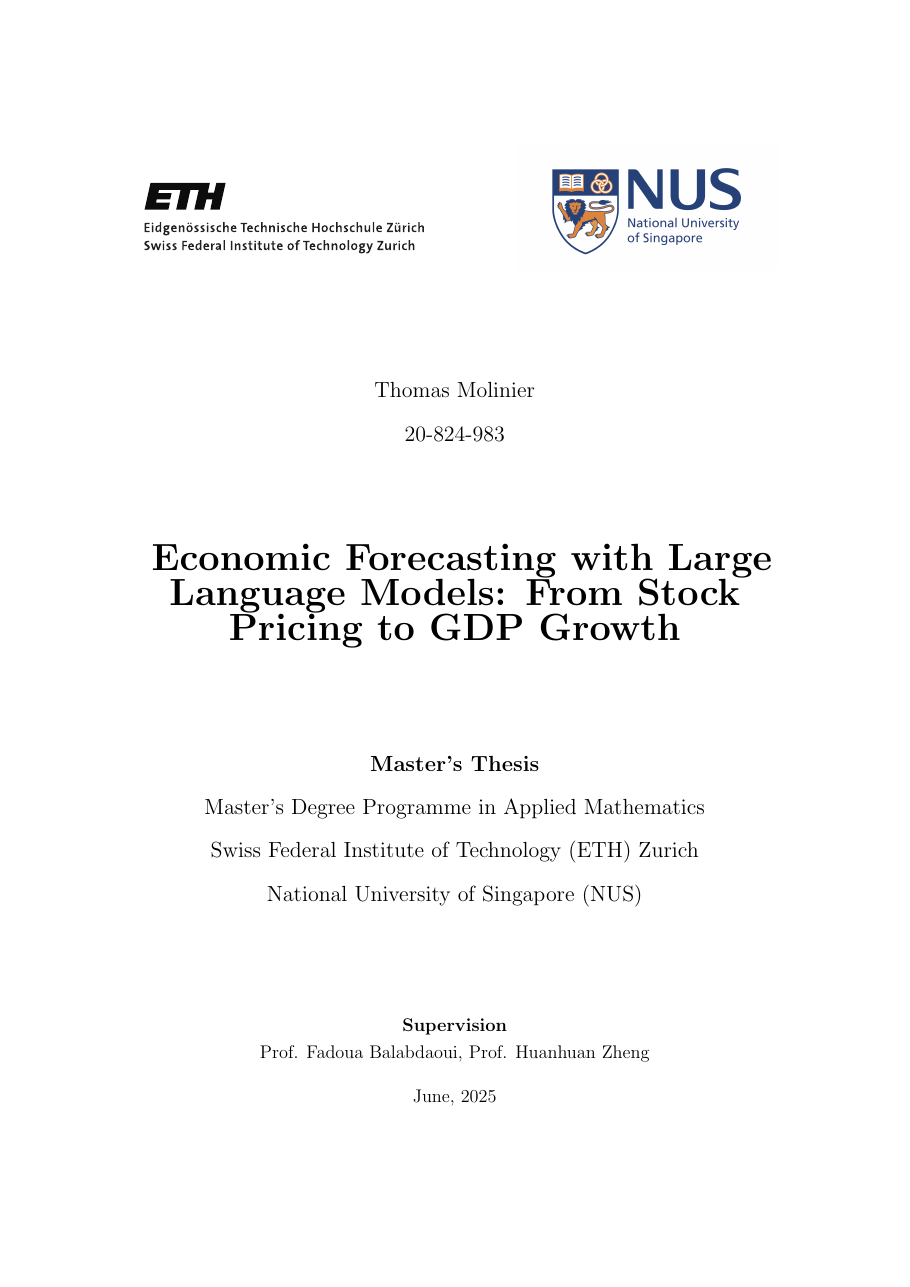
First page of Economic Forecasting with Large Language Models: From Stock Pricing to GDP Growth

Economic Forecasting with Large Language Models: From Stock Pricing to GDP Growth

Master thesis · ETH Zurich and National University of Singapore · June 2025

Two experiments on what LLMs can and cannot do with numbers. First, an LLM is placed inside a demand-based asset-pricing framework: it predicts institutional investor demand from stock characteristics, and prices follow. Fine-tuning with GRPO clearly improved the demand forecasts, but not enough to beat a simple price benchmark consistently. Second, a reasoning model reads a stream of real-time news and forecasts annual GDP growth. Benchmarked against the IMF, its forecasts were competitive and often more accurate for major economies such as the United States, China and Germany.
Supervision: Prof. Fadoua Balabdaoui, Prof. Huanhuan Zheng

Read the PDF

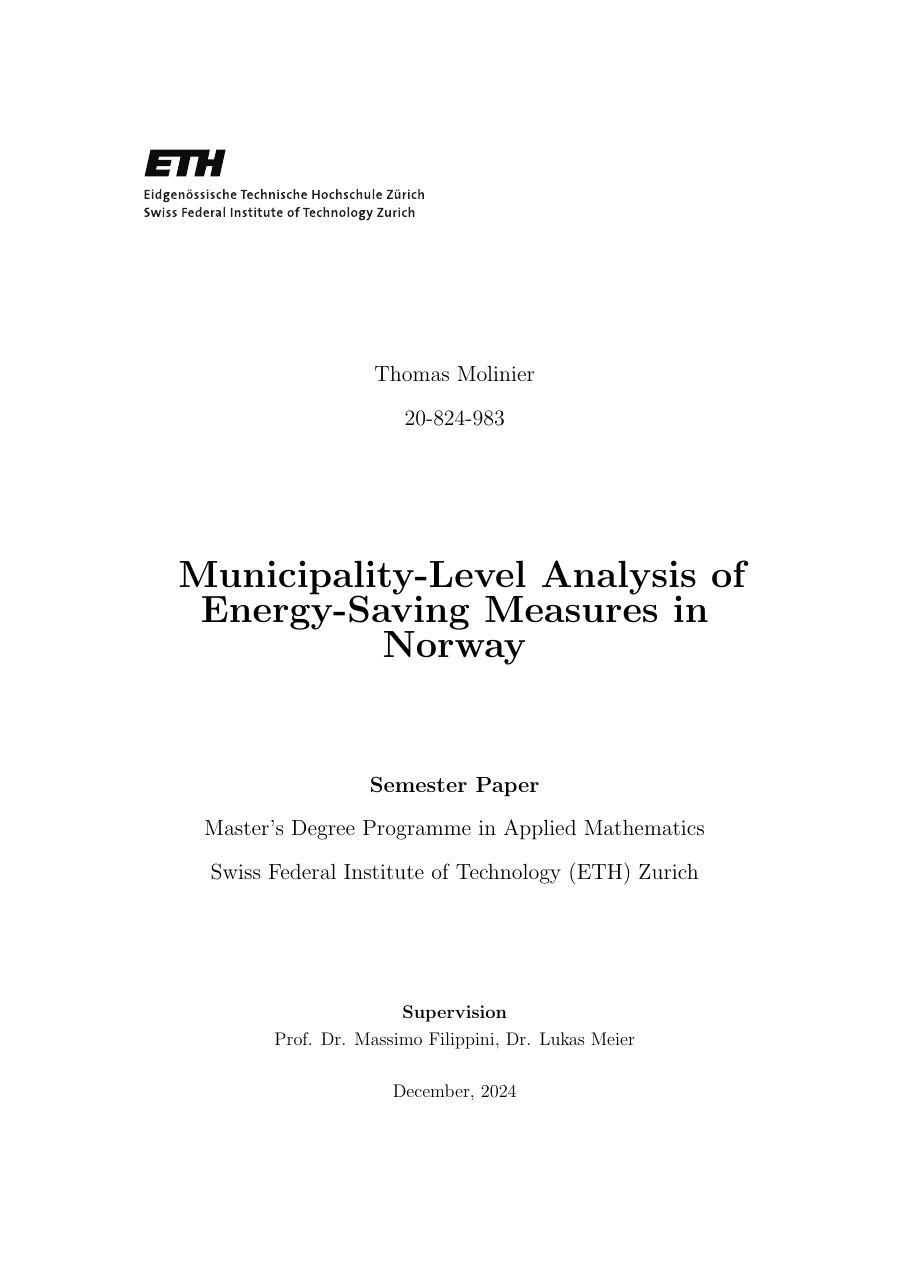
First page of Municipality-Level Analysis of Energy-Saving Measures in Norway

Municipality-Level Analysis of Energy-Saving Measures in Norway

Semester paper · Center for Energy Policy and Economics, ETH Zurich · December 2024

Why do some Norwegian municipalities embrace energy-saving retrofits while others lag behind? The paper combines ENOVA subsidy records with Statistics Norway socio-economic data into a panel of 356 municipalities over eight years (2015 to 2022), modelled with a negative binomial and two-way fixed effects. The clearest driver is the housing stock: a higher share of multi-dwelling buildings substantially reduces retrofit counts (coefficient −3.6, p = 0.003), even after controlling for income, education and subsidy generosity.

Supervision: Prof. Dr. Massimo Filippini, Dr. Lukas Meier

Read the PDF

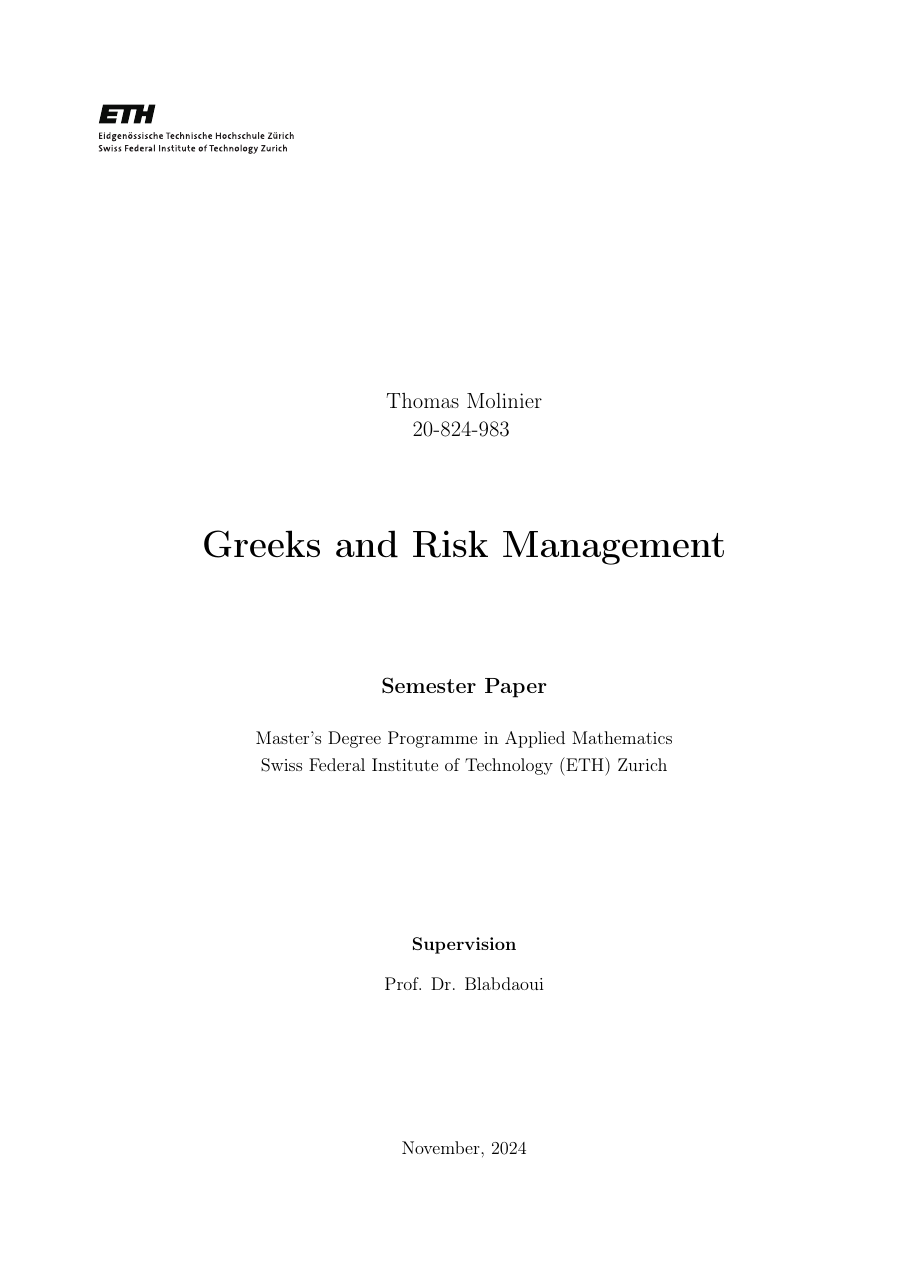
First page of Greeks and Risk Management

Greeks and Risk Management

Semester paper · ETH Zurich · November 2024

A walk through the Black–Scholes framework: closed-form expressions for the major Greeks of European options, then delta, gamma, vega and theta hedging worked out in Python on real market data. It closes on where the model breaks in practice, from volatility smiles and time-varying volatility to transaction costs.

Supervision: Prof. Dr. Fadoua Balabdaoui

Read the PDF

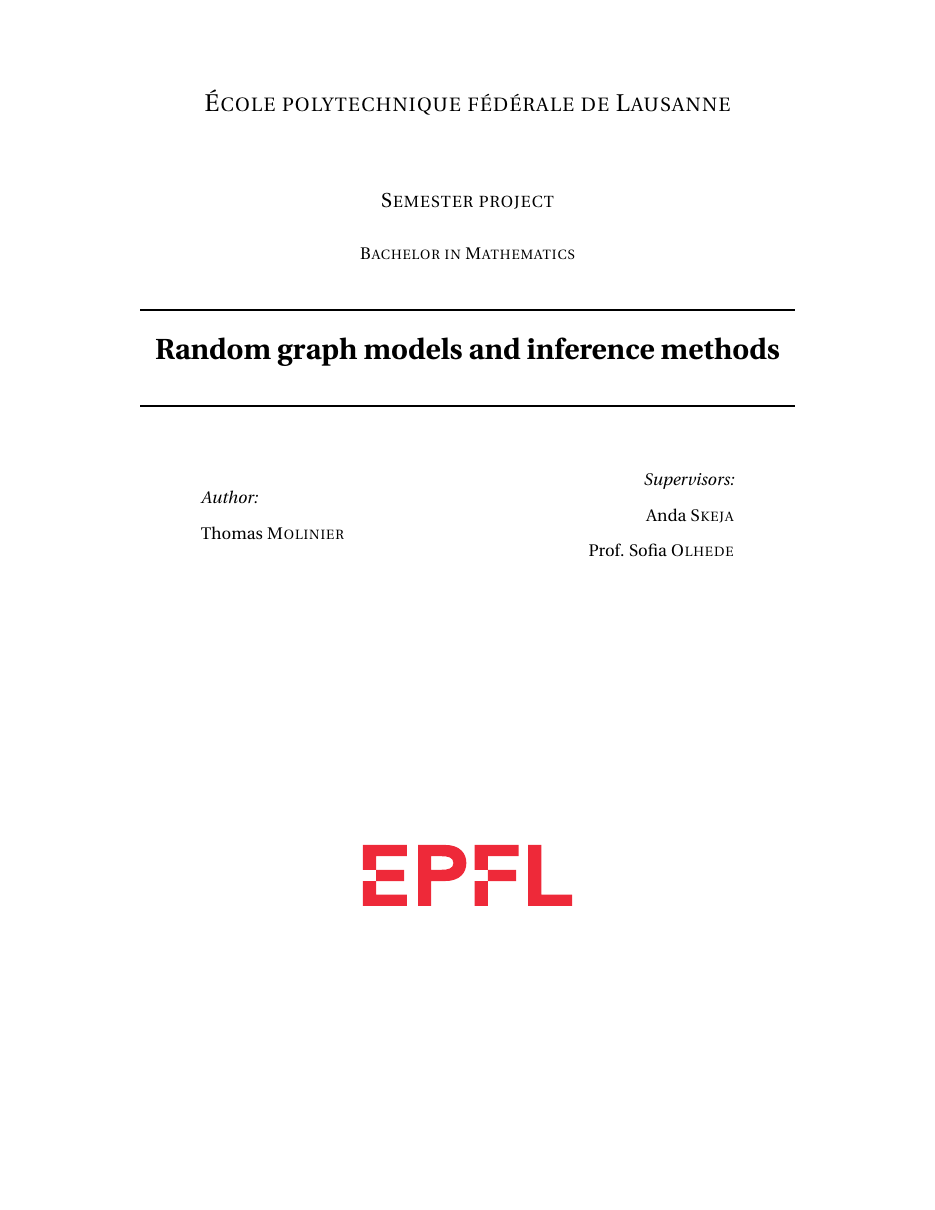
First page of Random Graph Models and Inference Methods

Random Graph Models and Inference Methods

Bachelor project · EPFL · 2023

How random graph models capture the structure of complex networks, and how to recover latent communities and parameters from a single snapshot. The project surveys Erdős–Rényi, configuration, stochastic block (SBM, DCSBM, MMSBM) and exponential random graph models, touches graph limits and graphon theory, and implements the practical inference side in MATLAB: spectral clustering, maximum likelihood, modularity and network histograms.

Supervision: Prof. Sofia Olhede, Anda Skeja

Read the PDF

Side

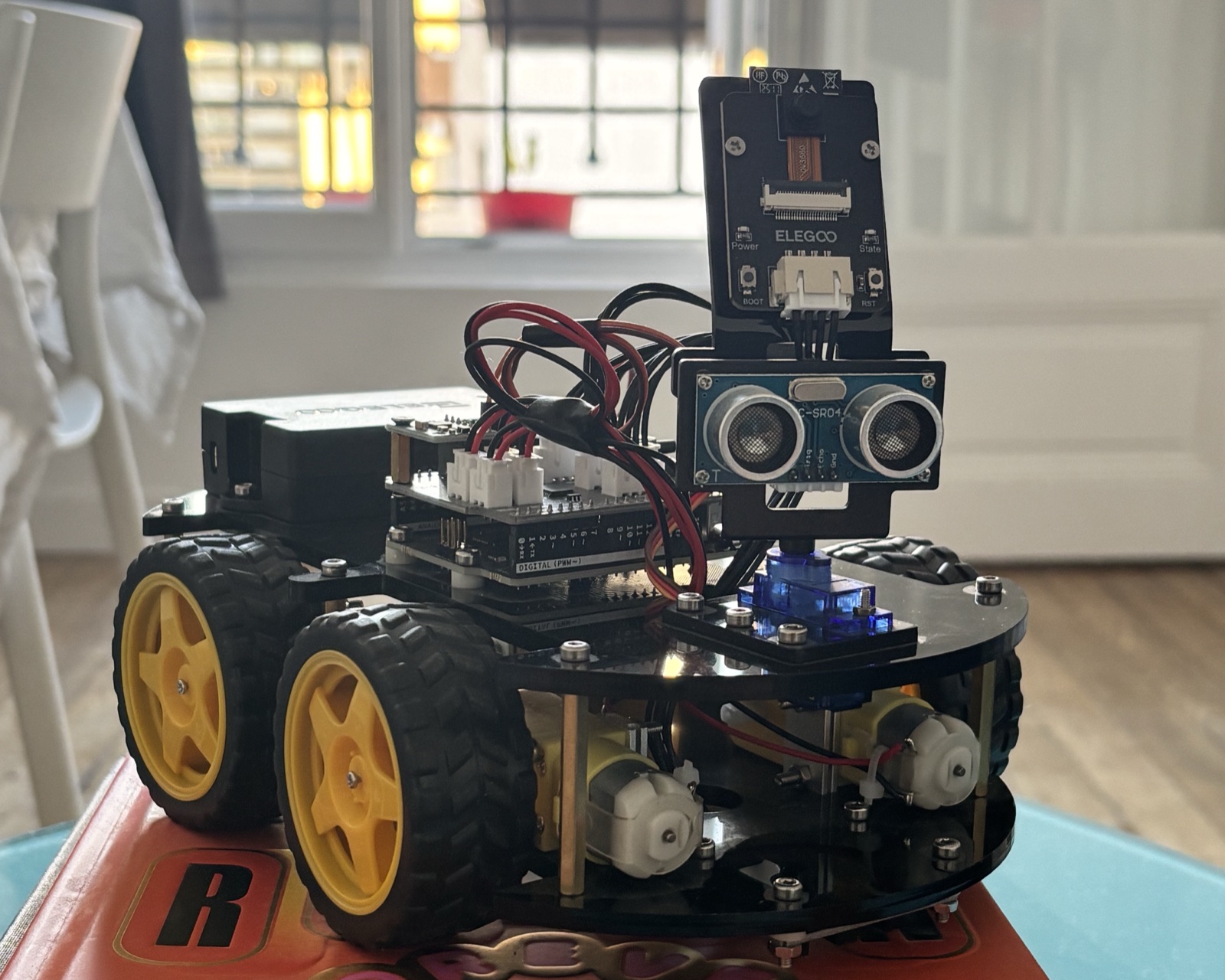
Robot

A robot car you can talk to · since May 2026

ELEGOO robot car on the floor

I bought an ELEGOO Smart Robot Car, an Arduino Uno chassis with an ESP32 camera head, and instead of the stock phone app I put a coding agent in the driver’s seat.

The robot exposes a Wi-Fi access point with a camera stream and a raw TCP socket that accepts small JSON commands. I mapped that protocol, wrote a Python CLI on top of it (drive, head servo, LEDs, ultrasonic and infrared sensors, status) and pointed Codex at it. Now I can say “go forward until something is closer than 30 cm, then look left” and the agent turns it into commands, reads the sensors and stops the motors when it is done.

Along the way: a local dashboard that overlays sensor readings on the camera feed with keyboard driving, a voice-control loop (speech to text, then an LLM that plans the actions), and a firmware patch that adds a battery-voltage command, compiled ten bytes under the Uno’s flash limit.

Catan

Top-6 world ranking · 2024 – 2026

Catan world ranking

Playing a strategy game at the highest level. Probabilistic thinking, search and heuristics, negotiation under uncertainty.

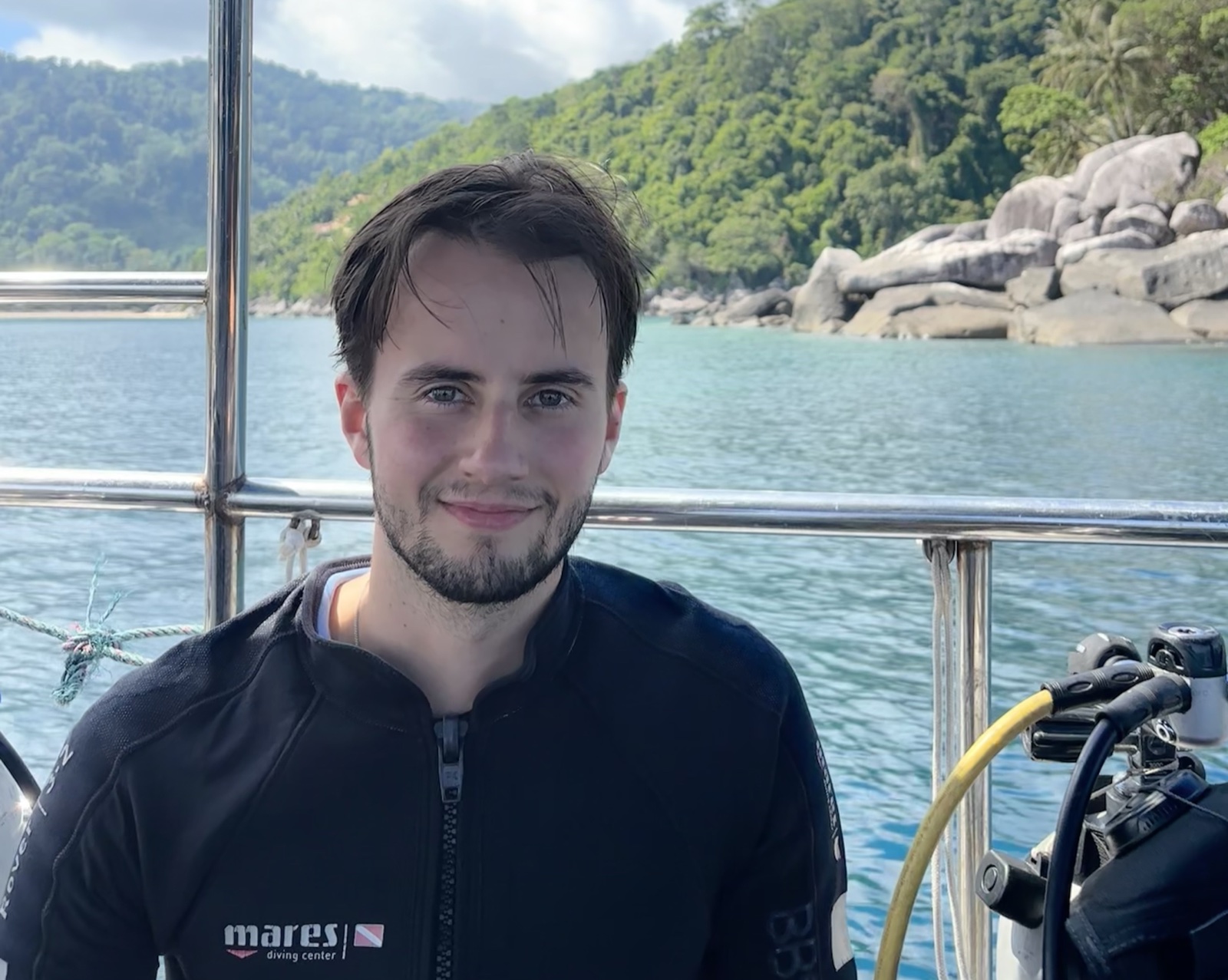
Diving

PADI Advanced Open Water · Tioman, Malaysia · 2025

Diving in Tioman

Open Water in January, Advanced in June. Dove inside a train wreck, a strange but great experience.

Forum EPFL

Committee member, student recruitment fair · Feb – Dec 2023

Organised Europe's largest student recruitment fair over a full week. 22k+ visitors, 187 companies, 128 start-ups, 18 NGOs and IGOs. I learned about teamwork, and delivering with not enough sleep.

Super-Coach, Maths Section

EPFL Coaching General · Aug 2021 – Aug 2022

Led a team of 33 coaches to integrate 250 first-year students.

National Mathematics Olympiads

Lyon · May 2019

Ranked top 19, top 0.5%.

How I work

A strong mathematical grounding (algebra, analysis, optimisation, statistics) that lets me understand models and algorithms at depth.

The level of abstraction in software is rising fast. My maths background helps me reason rigorously about models, data, uncertainty and system behaviour. For execution, I use AI coding agents as a force multiplier to ship quickly and reliably: I work daily with Codex, Claude Code, OpenClaw and Cursor, and beyond using agents I build the harnesses, from tools and MCP to context management, hooks and runtime guardrails.

I'm strongest at turning ambiguous business workflows and messy enterprise data into explicit ontologies, executable policies, measurable evaluations and production-ready agent products.

French (native) · English (fluent) · Spanish (beginner)